-
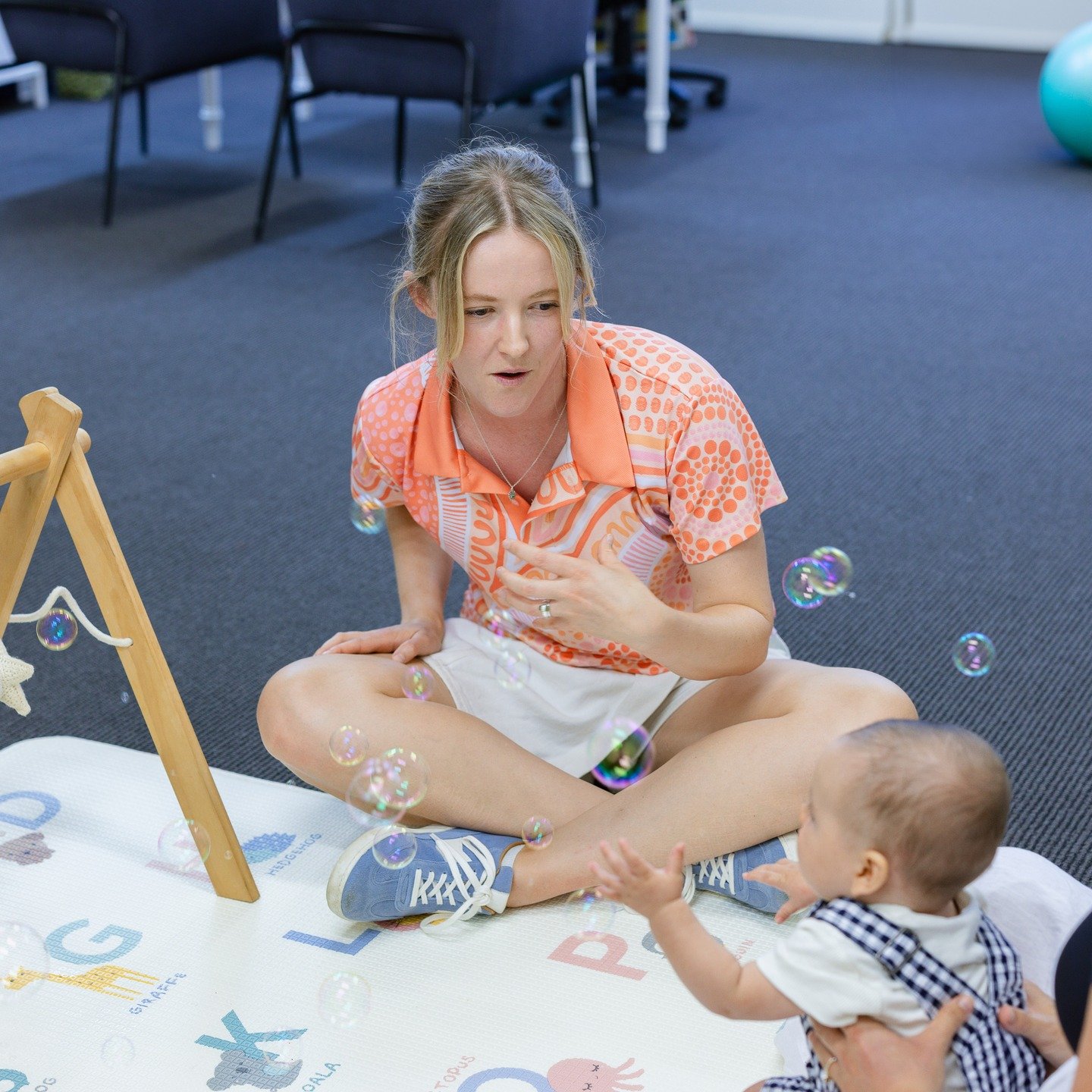
Adding gestures to your interaction is a great way to support language development.
Here is Old Macdonald Had a Fam with Aussie Animals from Key Word Sign Australia - https://www.youtube.com/watch?v=6Q8TXTdmJdE
Also check out this video from Key Word Sign Australia for the book “Where is the Green Sheep”. There are LOTS of signs discussed in this video.
-
Children can usually:
Understand about 10 words.
Respond to their name.
Recognise greetings and gestures, such as ‘hi’ and ‘bye-bye’.
Recognise a few familiar people and objects (e.g., mummy, blankie, teddy).
Make eye contact.
When it comes to speaking, children can usually:
Start to use sounds, gestures, and say a few words.
Continue to babble.
Copy different sounds and noises.
Tip:
When you talk to me, WAIT for me to respond before you say more.
Source: Speech Pathology Australia - find the downloadable version here
Another helpful resource here: https://www.asha.org/public/developmental-milestones/communication-milestones-birth-to-1-year/
-
Children can usually:
Understand up to 50 words and some short phrases.
Follow simple instructions (e.g., ‘throw the ball’).
Point to familiar objects when named.
Point to some pictures in familiar books.
When it comes to speaking, children can usually:
Say 6 to 20 single words – some easier to understand than others, but becoming more consistent.
Copy lots of words and noises.
Name a few body parts.
Use objects in pretend play (e.g., hold toy phone to their ear and say ‘hello?’).
Tip:
Get face-to-face with me when we communicate.
Source: Speech Pathology Australia - download the full resource here
A more in depth look here: https://www.asha.org/public/developmental-milestones/communication-milestones-13-to-18-months/
-
Children can usually:
Follow simple two part instructions (e.g., ‘give me the ball and the car’).
Respond to simple wh-questions, such as ‘what’ and ‘where’.
Point to several body parts and pictures in books when named.
Understand when an object is ‘in’ and ‘on’ something.
When it comes to speaking, children can usually:
Say more than 50 single words.
Put two words together (e.g., ‘bye teddy’, ‘no ball’).
Use their tone of voice to ask a question (e.g.,‘teddy go?’).
Say ‘no’ when they do not want something.
Use most vowel sounds and a variety of consonants (m, n, p, b, k, g, h, w, t, d).
Start to use ‘mine’ and ‘my’.
Source: Speech Pathology Australia - download the full resource here
-
Children can usually:
Follow more complex two part instructions (e.g., give me the teddy and throw the ball).
Understand simple wh-questions, such as ‘what’, ‘where’ and ‘who’.
Understand the concepts of ‘same’ and ‘different’.
Sort items into groups when asked (e.g., toys vs food).
Recognise some basic colours.
When it comes to speaking, children can usually:
Say four to five words in a sentence.
Use a variety of words for names, actions, locations and descriptions.
Ask questions using ‘what’, ‘where’ and ‘who’.
Talk about something in the past, but may use ‘-ed’ a lot (e.g., ‘he goed there’).
Have a conversation, but may not take turns or stay on topic.
Tip:
Figure out what I want to say, and put it into words for me.
Source: Speech Pathology Australia - download the full resource here
-
Children can usually:
Answer most questions about daily tasks.
Understand most wh-questions, including those about a story they have recently heard.
Understand some numbers.
Show an awareness that some words start or finish with the same sounds.
When it comes to speaking, children can usually:
Use words, such as ‘and’, ‘but’ and ‘because’, to make longer sentences
Describe recent events, such as morning routines.
Ask lots of questions use personal pronouns (e.g., he/ she, me/you) and negations (e.g., don’t/can’t).
Count to five and name a few colours.
Tip:
No need to always read the whole book. Talk about pictures that interest me.
Source: Speech Pathology Australia - download the full resource here
-
Children can usually:
Follow three part instructions (e.g., put on your shoes, get your backpack and line up outside).
Understand time related words (e.g., ‘before’, ‘after’, ‘now’ and ‘later’).
Start thinking about the meaning of words when learning.
Understand instructions without stopping to listen.
Begin to recognise some letters, sounds and numbers.
When it comes to speaking, children can usually:
Use well formed sentences to be understood by most people.
Take turns in increasingly longer conversations.
Tell simple, short stories with beginning, middle and end.
Use past and future verbs correctly (e.g., ‘went’, ‘will go’).
Use most speech sounds, but still may have difficulties with ‘s’, ‘r’, ‘l’ and ‘th’.
Source: Speech Pathology Australia - download the full resource here
-
Speech sounds typically develop in a certain pattern. Usually, children are using almost every sound correctly by 5 years of age.
Find more information here
-
Feeding is a multi-system task, it is the hardest thing your little one is learning to do! If you have concerns about your child’s feeding, please know that you are not alone.
Feeding matters - is a wonderful online resource with information about feeding difficulties and disorders. Start here if you are wondering about your child’s feeding.
Diet modification:
Starting solids:
-
For younger children, most of the sessions will be play-based. Click here to learn about the importance of play.